An impressive career at altitude
17 Jun 2026
Roland has been part of STRABAG PFS since 1975 and has progressed from being an electromechanical engineer to a specialist in mobile and digital radio technology.
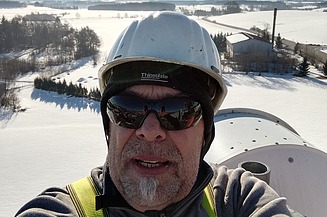
His journey shows just how much passion, team spirit and a love of technology can shape a working life. Even though he is eligible for a pension, Roland has no plans to stop. For 50 years, he has been working at lofty heights, braving wind and weather and sees his job not just as a career, but as a calling. In this interview, he talks about his career, how his work has changed and the importance of a strong team.
What motivates you to carry on working even after you’ve reached retirement age?
Roland: It’s quite simple: because I enjoy my work. I feel valued, both by my former team leader and by my current team leader. That means a great deal to me. My current working hours arrangement is ideal for me: three days, 22 hours. As long as it’s good for me, I’ll carry on.
How did your career begin, and which stages had a particular influence on you?
Roland: I started as an apprentice on 1 September 1975 in Ravensburg, back then at the telecommunications office under the Post Office. We were the first team there to set up modern safety equipment for working at height. I trained as an electromechanic and developed my skills step by step: first in electronics, then in refrigeration technology and finally in industrial climbing. Just like my employer, which was first DeTeImmobilien and later became STRABAG PFS. I also had the chance to move into the middle management ranks at one point, but I made a conscious decision not to.
How did you come to switch to mobile and digital radio technology?
Roland: Mobile communications was becoming an increasingly integral part of my day-to-day work. The client at the time wanted its own team for mobile and digital radio. That was a risk back then. Nobody knew whether it would pay off in the long run.
I was offered a job guarantee, but not in my previous role. Looking back, it was one of the best decisions I’ve ever made: exciting projects, brilliant colleagues, even though they were spread across many different sites.
What is it that makes this job so special for you, even today?
Roland: I love the combination of working independently, constantly visiting new locations and tackling technical challenges. Every day is different.
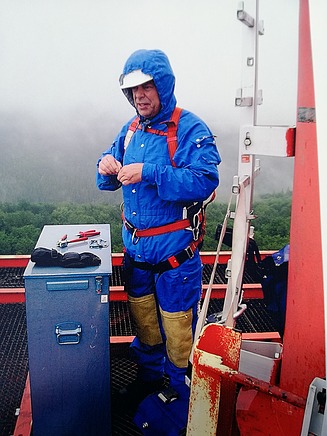
And then, of course, there’s the climbing itself. It’s never lost its appeal – quite the opposite: over the years, it’s also become my hobby. I’ve also been working as a climbing instructor in the mountains for around 40 years.
But one thing is clear: this job wouldn’t work without colleagues you can rely on one hundred per cent.
What role does the team play in your day-to-day work?
Roland: A crucial one. I owe at least 50 per cent of my success to my colleagues. Without trust, team spirit and professional collaboration, this job wouldn’t be possible.
This applies to everyone involved from the tradespeople through to the scheduling team and the administrative staff. And I can honestly say that my experiences with our managers have been consistently positive.
How has your work changed over the last 50 years?
Roland: Technically speaking, everything has changed. In the past, it was mainly about TV and radio stations; later, it was about microwave links; and from the 1990s onwards, it was about a huge number of new mobile phone masts.
The way we work is different too: in the past, we’d come into the office, pick up our work cards and set off, often without much coordination. On the towers, there were landline phones or two-way radios.
Today we work with modern technology and very clear processes. There are regular training sessions and well-thought-out emergency response plans. We always work in teams of at least two. We carry out maintenance and repairs ourselves, whilst larger installations are handled by specialist partner companies.
What advice would you give to the younger generation looking to enter this profession?
Roland: A mobile phone or laptop won’t fix cables. Our work is physically demanding, technically complex and takes place whatever the weather.
And what are your hopes for the future?
Roland: On a personal level, above all, good health. And professionally: that I can carry on as long as I enjoy it. If things stay that way, I can well imagine still being up in the tower even at 70.
We wish you all the best for your future, both professionally and personally, dear Roland!