From landscape gardener to value stream manager
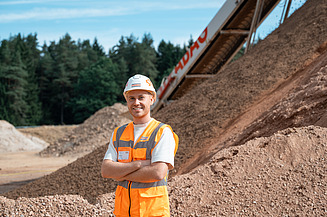
How did you come to work as a value stream manager and join STRABAG?
Felix: My career began with an apprenticeship as a landscape gardener. As I was fascinated by construction processes and infrastructure right from the start, I subsequently decided to study landscape architecture. Earthworks, in particular, had me hooked right from the start. I’d actually planned to go to Australia for my work placement semester whilst at university, but in the end it turned out to be Austria. That’s how I ended up at STRABAG in Tyrol, where I was able to gain my first practical experience in transport infrastructure and civil engineering, working directly on the renovation of a bridge near Innsbruck. After that, I remained with STRABAG as a working student in construction engineering, working, amongst other things, on cost accounting at Munich Airport and in Grafenwöhr.
I actually came to value stream management via a bit of a detour: During a training course on the new Substitute Building Materials Ordinance, I found myself wondering what the changes actually meant in practical terms for our construction sites. It was precisely this question that became the starting point for something new.
I then asked my line manager if I could write my Bachelor’s thesis on the subject. This led to me making contact with the Executive Staff Office, and I was able to delve ever deeper into the topic.
My Bachelor’s thesis eventually led to something more: my introduction to value stream management.
At that time, value stream management was still in its infancy. When it became clear that a dedicated role was to be created for this within the Munich head office, I realised straight away: this is my chance to help shape a new field from the very beginning.
Which stages of your career have had a particular impact on you?
Felix: Definitely my time in Innsbruck. Not just professionally, but personally as well. It was the first time I’d spent a long period away from my familiar surroundings – in another country, with different building regulations and new procedures. You have to adapt quickly to new situations, and you learn an enormous amount in the process.
What really stuck with me, though, was the topic of reuse: seeing how materials from existing buildings can be recycled and reused. It’s precisely this combination of practical experience, innovation and sustainable construction that I still find fascinating to this day.
What does a value stream manager do? How would you explain your job to someone who’s never heard of it?
Felix: In short: I try to put the circular economy into practice on the building site. I oversee construction processes from start to finish and look for ways to save resources, reuse materials and make processes more efficient. At the same time, it’s about ensuring we comply with environmental regulations and legal requirements.
You’re currently working on the SuedOstLink project. What are your role and responsibilities there?
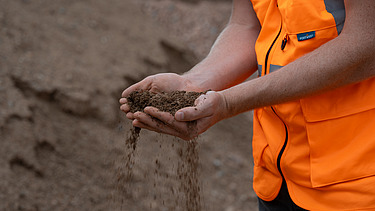
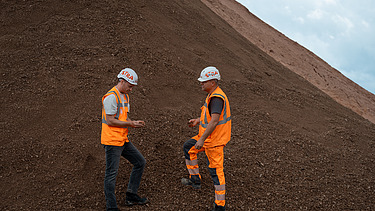
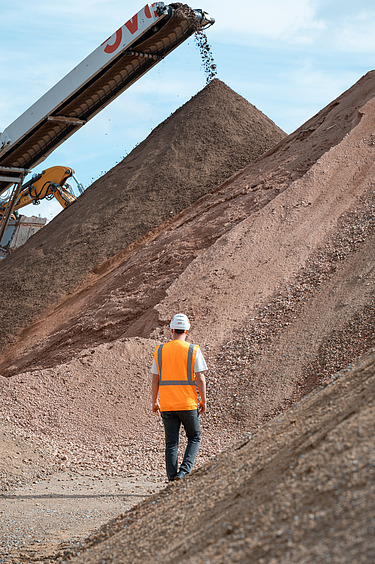
Felix: On the SuedOstLinkproject , I’m part of the site management team for the material processing area. In the processing areas, the material excavated from the pipe trench is processed so that it can subsequently be reused for backfilling the pipeline zone.
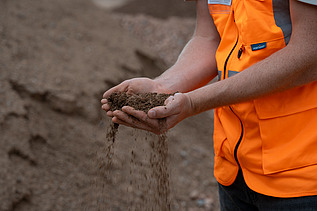
The material varies depending on the section of the route and the respective ground conditions. Therefore, the excavated soil must be screened, mixed or blended with aggregates accordingly before it can be reused for backfilling. Together with TPA, our in-house testing laboratory, I develop the appropriate mix designs and ensure that the processed material meets the required quality standards.
In my day-to-day work, this means keeping the processing operations running smoothly and coordinating on-site procedures. This involves managing material flows, organising transport and keeping track of the volumes of material generated and those already processed. Digital solutions help me to coordinate material flows and processes efficiently and to keep track of the project’s progress.
The aim is always the same: to return as much material as possible to the cycle and to minimise the amount that needs to be disposed of.
What challenges does a project of this scale pose for value stream management?
Felix: In a project of this scale, proper planning of material flows plays a crucial role. The route is divided into various geogenic and homogeneous areas. Material from a specific area may only be reused within the same geogenic area.
It is therefore essential to produce material in good time and process it at logistically sensible locations – as close as possible to where it will later be needed. At the same time, the mix designs must be tailored so that as little material as possible is left over and needs to be disposed of.
What are the most effective ways to optimise time and resources on a project such as the SuedOstLink?
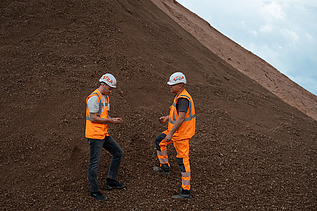
Felix: A crucial factor is the early and detailed survey of the route. If I know as precisely as possible what properties the existing soil has in each individual area, I can plan in advance which material from which cluster is to be transported to which processing area. Suitable mixtures can be specifically formulated from the existing soils. This enables us to significantly reduce the use of aggregates whilst ensuring a steady supply of materials.
This is precisely where I see one of the greatest levers: through forward-looking planning, we can make the best possible use of existing soils, reduce transport distances and keep valuable resources in the cycle.
-
-
-
-
-
What does a typical working day look like for you? Is there even such a thing?
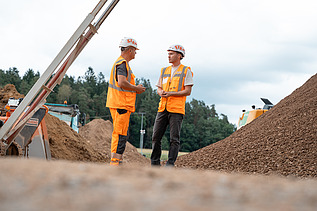
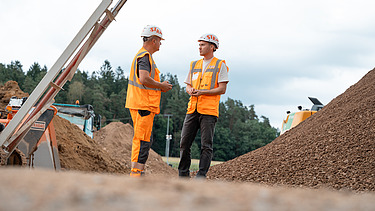
Felix: There actually is – even if every day is a bit different. An important part of my job is coordinating between track construction, processing and the TPA (Technical Testing Institute, i.e. quality assurance): What quantities are required? What can be processed? And how do we coordinate both so that the construction site runs smoothly?
To this end, I’m in regular contact with the foremen on the processing sites, the track-laying teams and the building materials inspectors. Ultimately, it’s all about ensuring the right materials are in the right place at the right time – and that the construction process keeps moving forward.
Do you spend more time in the office, in meetings or out on site working on projects?
Felix: Without a doubt: outon site working on projects. I spend around 50 to 60 per cent of my time on operational communication and out on site. About 20 to 30 per cent is taken up by documentation and controlling. Meetings account for the smallest share, at a maximum of 20 per cent.
Which departments and teams work particularly closely with you?
Felix: My job thrives on collaboration with many different teams. I work particularly closely with the foremen and forewomen in charge of the processing areas – there are currently three active areas, each with its own designated person in charge.
On the track-laying side, I’m in regular contact with the site managers – and sometimes also with the foremen and senior site management. In addition, there are colleagues from the accounts department, financial control, value stream management and project management. In fact, my work brings many different areas together.
In your view, which skills are particularly important for a value stream manager?
Felix: I think experience on a building site is a key foundation. You should know how a building site operates – ideally based on your own commercial or practical experience. For me, this includes a good understanding of construction site logistics, machinery, material flows and an understanding of human nature.
Expertise in environmental issues, the circular economy and geotechnical engineering is also important, as is a basic understanding of the legal framework.
However, personal skills are at least as crucial: communicating effectively, being open to new ideas, thinking analytically and finding creative solutions. After all, value stream management is all about recognising interconnections and finding new ways to make processes better and more efficient.
If you had to change jobs tomorrow, what would you miss the most?
Felix: I think what I’d miss most of all would be the direct link to the building site. It’s quite different whether you’re working on a project on paper or seeing first-hand on site what works and where adjustments are still needed. I also like the fact that I don’t just see a small part of the project, but can link lots of different processes together. It’s probably this mix of the building site, coordination and developing solutions that I’d miss the most.
What advice would you give to young people considering a similar career path?
Felix: Above all,I’d say: stay open-minded and be curious. Things are constantly evolving in this field – which is why it’s worth keeping up to date with the latest developments and remaining open to new solutions.
And: you should learn not to be too quick to dismiss materials as waste. It is precisely this mindset that is crucial to the circular economy.
Thank you very much for the fascinating insights into your career path, Vince. We wish you all the best for the future!